


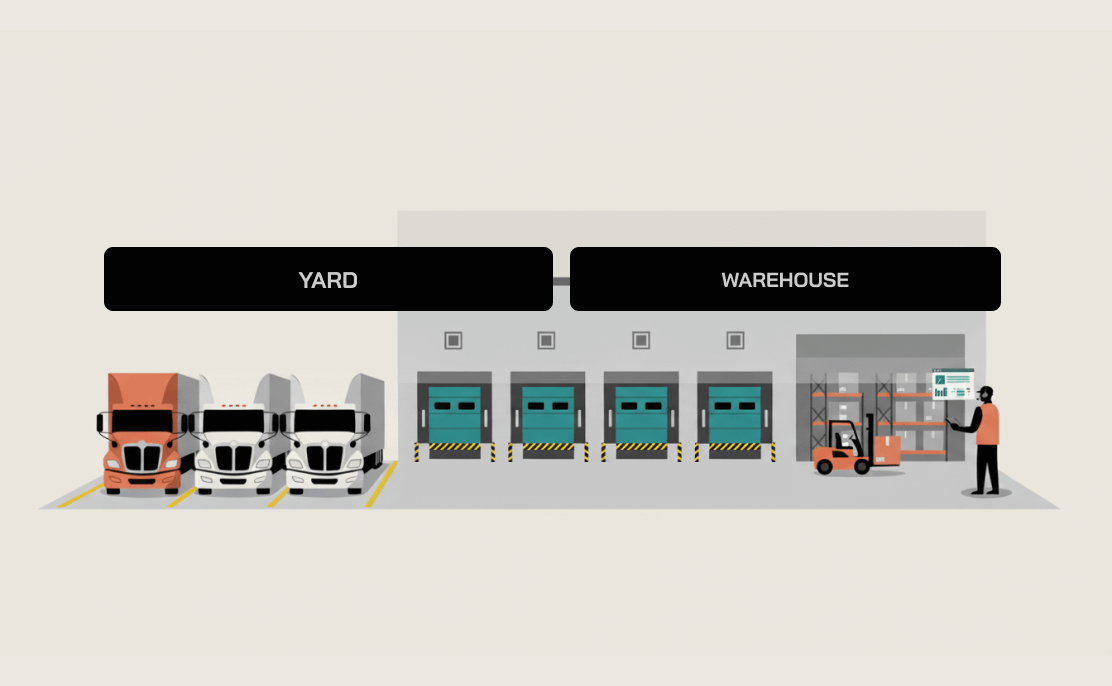
Your warehouse management system handles what happens inside your four walls. Inventory location, pick paths, labor allocation, fulfillment SLAs. But the yard sits outside that system boundary, which creates a natural gap in visibility.
When we talk to operations teams, the same pain points come up: trailers sitting idle for hours, drivers circling the lot looking for open docks, detention fees stacking up, and yard audits that still rely on someone walking the lot with a clipboard.
This article breaks down the difference between yard management systems (YMS) and warehouse management systems (WMS), why most operations benefit from both, and how to evaluate whether YMS belongs on your roadmap.
What a WMS Does
A Warehouse Management System (WMS) is purpose-built to manage inventory and labor inside the warehouse. It tracks what's on your shelves, where it's located, who's picking it, and when it ships. Good WMS platforms optimize slotting, wave planning, and put-away logic. They give you visibility into fulfillment performance and help you hit SLAs.
If your operation runs on tight inventory control and labor efficiency, your WMS is probably doing its job.
But most WMS platforms treat the dock door as the boundary. Once a trailer enters your yard, and before it's checked into a door, you're operating without real-time data.
What a YMS Does
The yard is the buffer zone between your warehouse and the transportation network. It's where trailers queue, where appointments stack up, and where delays quietly compound before they ever hit your receiving team.
Without a Yard Management System (YMS), yard operations typically look like this:
- Gate check-ins tracked on paper or spreadsheets
- Yard jockeys driving the lot to find trailers manually
- No real-time visibility into which trailers are loaded, empty, or ready to move
- Dock scheduling disconnected from yard capacity
- Detention fees that are difficult to trace back to root cause
A YMS brings structure to these workflows. It automates gate check-in, tracks trailer location and status in real time, coordinates dock assignments, and gives your team a single view of what's in the yard and what needs to move next.
WMS vs. YMS: Quick Comparison
Why You Need Both
A reasonable assumption: "If I upgrade my WMS, I'll get yard visibility too."
But most WMS yard modules are lightweight add-ons rather than purpose-built systems. They might give you basic dock scheduling, but they rarely handle real-time trailer tracking, automated yard moves, or integration with gate hardware.
Think of it this way: your WMS manages the warehouse. Your TMS manages transportation. Your YMS manages the handoff between them.
[visual placeholder]
When these systems work together, you get end-to-end visibility. When the yard is left out, you get bottlenecks that ripple upstream and downstream.
Common Concerns
When we talk to supply chain leaders about YMS, we hear a few common concerns. Let's address them directly.
"It's a heavy lift to automate the yard."
That used to be true. Legacy YMS platforms required months of implementation, custom hardware, and significant IT resources. But the technology has changed. MModern YMS providers like Technova Industries and Terminal Industries have built cloud-native platforms that deploy in days rather than months. AI-driven automation handles tasks that used to need manual configuration, and infrastructure requirements are a fraction of what legacy systems demanded.
"The infrastructure is too expensive."
This depends on the solution. Some older platforms require fixed RFID readers, in-ground sensors, and dedicated servers. Newer systems leverage mobile devices, GPS tracking, and camera-based recognition, which dramatically lowers the cost of entry. The question isn't "what does infrastructure cost?" but "what's the right architecture for my operation?"
"The payback takes too long."
For complex, capital-heavy implementations, payback used to stretch into years. With modern YMS platforms, many operations see ROI in months. Detention fee reduction alone often covers the investment. Add in labor savings from automated yard moves and dock utilization improvements, and the math shifts quickly.
"I have bigger priorities right now."
Fair. But consider this: yard inefficiency doesn't show up as a single line item. It hides in detention fees, in delayed shipments, in overtime for yard jockeys, and in customer penalties you can't fully trace back to root cause. If your warehouse runs well but your yard creates unpredictable delays, the yard might be a bigger priority than it appears.
How to Get Started
If you're evaluating whether YMS belongs on your roadmap, start here:
- Audit your current yard operations. How do you track trailers today? What's your average dwell time? How often do drivers wait for dock assignments?
- Quantify the cost of inaction. Pull your detention fee data. Estimate labor hours spent on manual yard tasks. Identify how often dock congestion delays inbound or outbound shipments.
- Assess integration requirements. Your YMS needs to talk to your WMS and TMS. Look for platforms with proven integrations or flexible APIs.
- Evaluate vendors and implementation partners. Look for a partner who matches the solution to your operation rather than pushing a standard template.
Prism Solutions works with leading YMS providers, including Technova Industries and Terminal Industries, to help supply chain teams navigate this decision. We've seen what works across 3PL, manufacturing, and retail distribution environments, and we can help you find the right fit for your operation.
Ready to explore whether YMS fits your operation? Get in touch with our team.
Frequently Asked Questions
Q. Can YMS integrate with existing WMS?
Yes, modern YMS solutions integrate with major WMS platforms through APIs that enable real-time data exchange. Integration connects yard visibility with warehouse operations to eliminate manual coordination steps and create seamless handoffs.
Q. What size facility needs yard management?
Facilities with 10+ docks processing 50+ trailers daily typically benefit most. Lower volumes can manage with manual coordination, but high-volume cross-dock or multi-site operations require YMS regardless of dock count to maintain efficiency.
Q. What problems does yard management solve?
YMS eliminates trailer tracking issues, reduces detention fees, improves dock utilization, and provides real-time visibility into yard operations. It solves coordination problems between warehouse and transportation that manual processes can't handle at scale.